Nano-gold embedded in thin films creates ultrathin flexible material that turns small temperature changes into electricity for future smart devices.
Nano-gold embedded in thin films paves the way for self-powered sensors and wearable electronics. Researchers have created a new ultrathin flexible film that efficiently converts small temperature fluctuations into electrical signals.The development could support future smart photodetectors, low-grade heat harvesters, and advanced flexible electronic systems for healthcare, environmental monitoring, and energy-efficient devices.There is strong demand for lightweight, flexible, and low-power materials that can turn tiny thermal changes into usable electricity for next-generation smart devices and autonomous sensors. Earlier plasmonic-pyroelectric and PVDF composite systems showed improved performance, but many used thicker devices or less controlled interfaces. These limitations made them less suitable for thin, wearable, and low-power electronics.
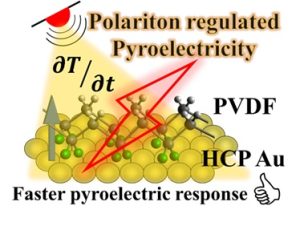
Nano-gold embedded in thin films addresses these challenges. Scientists from the Institute of Nano Science and Technology (INST), Mohali, an autonomous institute of the Department of Science and Technology, demonstrated that adding a small amount of nanogold to a common ferroelectric polymer greatly improves its pyroelectric performance. Pyroelectric performance is the ability to generate electricity from temperature changes.The team, led by Prof. Dipankar Mandal and including Sudip Naskar, engineered ultrathin films using polyvinylidene fluoride (PVDF). PVDF is a flexible polymer commonly used in electronics and sensing. They used a low-dose in-situ nanogold strategy to study nanoscale gold-polymer interactions, dipole orientation, and confined plasmonic excitations.
By adding hexagonal nanogold particles into films thinner than 100 nanometres, the researchers achieved a nearly pure polar phase of PVDF with highly ordered dipoles. This structure is key for strong pyroelectric behaviour.The research, published in Advanced Functional Materials, shows that a polymer-supported metastable hexagonal closed pack phase of gold nanoparticles and a highly ordered polar phase of the PVDF matrix can combine into a strong 2D hybrid thin film. In this film, plasmon-dipole-electron coupling works together to enhance pyroelectricity, dipole ordering, and broadband optical absorption.Nano-gold embedded in thin films demonstrated efficient pyroelectric energy conversion in an ultrathin film over a small temperature range of 294 to 301 K. This result meets an important need for ambient-temperature thermal sensing and wearable energy harvesting technologies.
The new approach offers a path for high-speed, low-power, self-powered devices that respond to both thermal and optical stimuli. It combines plasmonic properties with pyroelectric polymers in very thin formats suitable for real-world flexible electronics.This development is expected to help create better autonomous sensors and wearable systems that operate without external power sources. Users can look forward to lighter, more efficient devices in healthcare monitoring and environmental applications in the coming years.
Also Read: Government Imposes Strict Cap on Duty-Free Gold Imports at 100 Kg