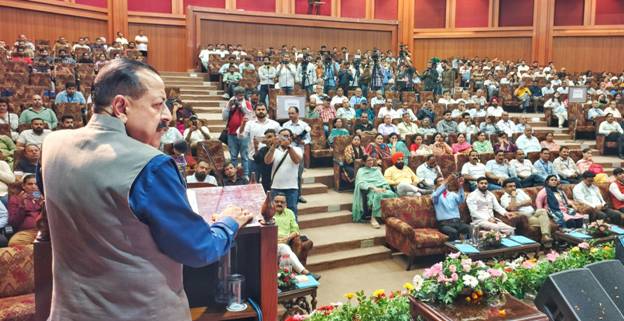
Dr Jitendra Singh has launched the Jammu Regional Meteorological Centre. The Union Minister for Science & Technology and Earth Sciences inaugurated the facility today, making it India’s seventh Regional Meteorological Centre.
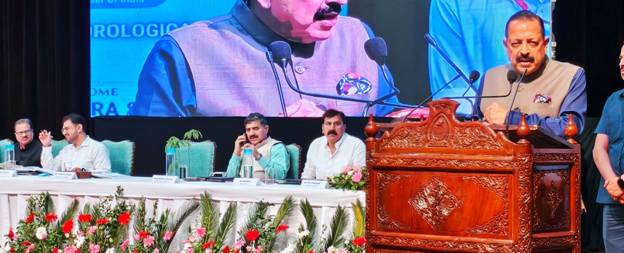
The new Jammu Regional Meteorological Centre will serve Jammu & Kashmir, Ladakh and Himachal Pradesh. It will provide specialised weather services, disaster warnings and climate support for the Himalayan region.The centre will deliver district-level forecasts, mountain weather forecasts, tourist advisories and city-specific services. It will also issue timely warnings for flash floods, cloudbursts, avalanches, heavy snowfall, thunderstorms and landslides.
These services are expected to help pilgrims on the Amarnath and Vaishno Devi yatras, farmers, transport operators, hydropower projects, disaster management agencies and security forces working in difficult terrain.
Expansion of Weather Infrastructure
Dr Jitendra Singh highlighted major growth in meteorological infrastructure in Jammu & Kashmir and Ladakh over the past decade. In 2014, the region had no Doppler Weather Radar. Today, four are operational at Jammu, Srinagar, Leh and Banihal Top.Under Mission Mausam, five more Doppler Weather Radars are proposed for Anantnag, Rajouri, Baramulla, Kishtwar and Doda
The observational network has also grown. The region now has 56 observatories, including 15 manual observatories, 25 Automatic Weather Stations and 16 Automatic Rain Gauges. This is a big increase from 13 AWSs and 14 ARGs in 2014.New AWSs have been installed at Kargil, Ukhral in Ramban district and Mata Vaishno Devi Bhawan. Nearly eight more AWSs and five ARGs are planned for installation this financial year. The number of stations under the Daily Rainfall Monitoring Scheme has risen from 30 in 2014 to 85 now.
Restructuring of Regional Operations
The establishment of the Jammu Regional Meteorological Centre marks an important change in the India Meteorological Department’s setup. Earlier, the Delhi centre handled weather services for a large area including J&K, Ladakh, Himachal Pradesh, Uttarakhand, Punjab, Haryana, Uttar Pradesh and Rajasthan.With the new Jammu centre, weather services for Jammu & Kashmir, Ladakh and Himachal Pradesh will now be managed from Jammu. A similar centre planned for Lucknow will cover Uttar Pradesh and Uttarakhand.
Scientific Initiatives and Monitoring
Dr Jitendra Singh noted several other initiatives in the region. The Meteorological Centre at Srinagar has signed collaborations with Sher-e-Kashmir University of Agricultural Sciences and Technology (SKUAST)-Jammu, SKUAST-Kashmir and the Islamic University of Science and Technology for research and capacity building.A High-Altitude Cloud Physics Laboratory has been set up at Patnitop in collaboration with Swiss scientific institutions for cloud and aerosol studies.
On earthquake monitoring, the Jammu and Kashmir seismological network has been modernised. Seismic stations have been upgraded to digital systems and a new observatory added at Udhampur. Five seismic stations are now operational across Jammu & Kashmir and Ladakh, sending near real-time data to the National Centre for Seismology.An Automatic Weather Station and a seismology centre will be established in Kishtwar after last year’s disaster there. The Srinagar Meteorological Observatory, over a century old, has been recognised by the World Meteorological Organization as a Centennial Observing Station.
Improved Forecasts and Warnings
“Now there will be regional forecasts, district-wise forecasts, separate forecasts for tourists and separate mountain forecasts,” Dr Jitendra Singh said. He added that customised forecasting would meet the specific needs of the Himalayan region.“Flash floods, cloudbursts, avalanches, heavy snowfall, thunderstorms and landslides — all of these will be forecast in a timely manner,” the Minister stated.The new Jammu Regional Meteorological Centre is expected to significantly improve weather monitoring, forecasting and early-warning systems for people living in and visiting the region.